
9 Screen-Free Activities for Kids Ages 5–9 That Don’t Feel Like Homework
The best screen-free activities rarely announce themselves as educational.
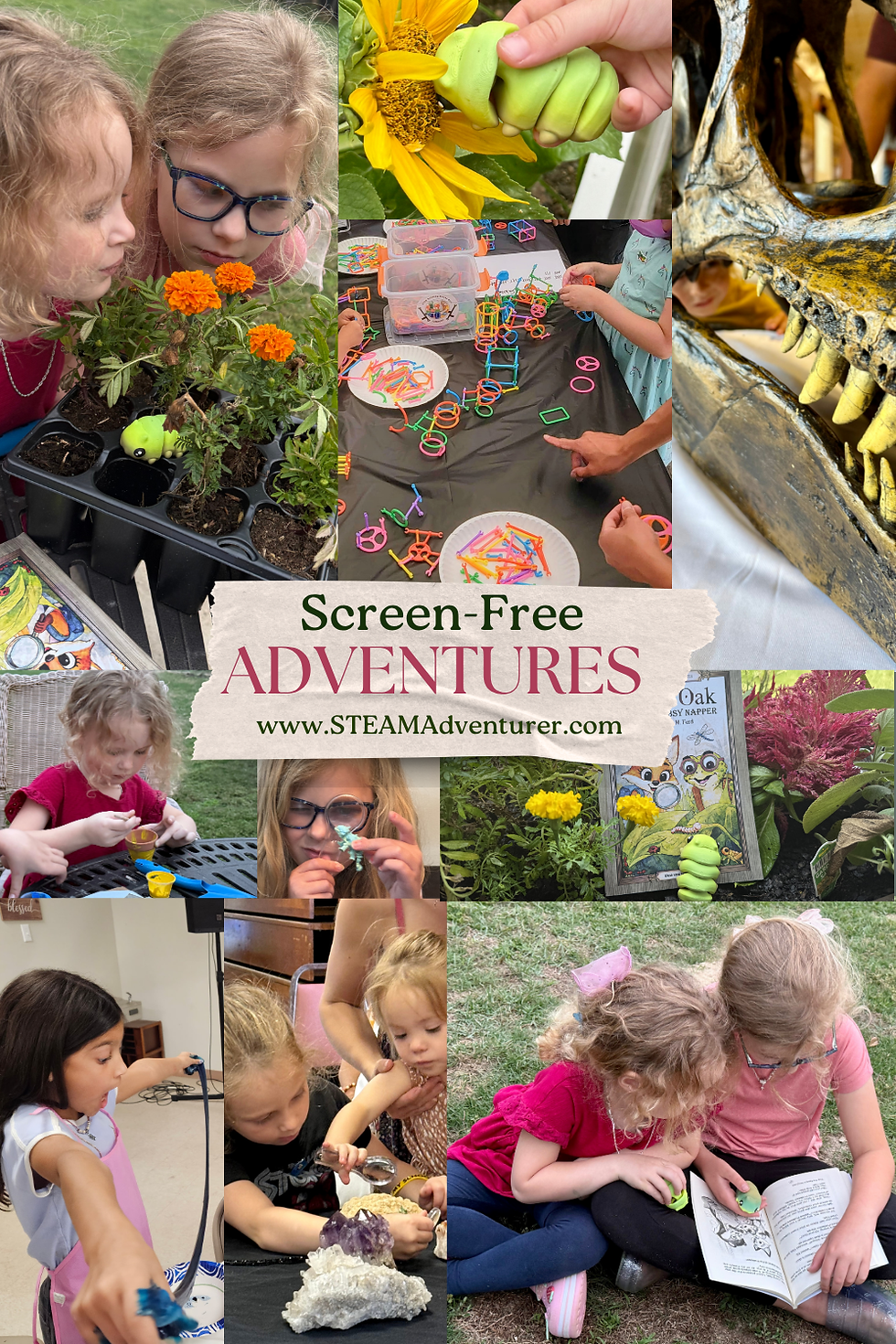
They look like a child crouched beside a flower for ten minutes, an increasingly
complicated cardboard invention taking over the dining room, or a blanket fort that has somehow acquired laws, currency, and a border patrol.
Children ages 5 to 9 are wonderfully capable and still gloriously imaginative. They can follow directions, make predictions, read independently, and work through a challenge, but they can also turn a spoon into a catapult and a patch of weeds into an unexplored jungle.
The goal is not to ban screens or keep children entertained every minute. It is simply to make sure the rest of childhood still gets a turn.
Here are nine screen-free adventures that give children something interesting to notice, make, test, collect, or imagine.
1. Take a Micro-Expedition
An adventure does not need to cover several miles.
Choose one small area, perhaps the backyard, one section of a park, or even the space around a single tree, and investigate it closely.
Try one of these:
Find five different shades of green.
Sit quietly and make a map of every sound you hear.
Search for something smooth, something rough, and something surprisingly tiny.
Choose one square foot of ground and count how many living things pass through it.
Follow an ant without disturbing it and see where it goes.
Children often hurry through familiar places because they assume they already know what is there. A micro-expedition invites them to look again.
For a larger outing, families can use the National Park Service Find a Park tool to search for parks, historic sites, trails, and other places to explore.
2. Touch Dirt
Instead of simply saying, “Let’s plant something,” give the garden a purpose.
Create a pizza pot with basil, tomatoes, and oregano. Plant flowers chosen specifically for butterflies. Grow mint for summer drinks. Let each child choose one mystery seed and make predictions about what it will become.
Children can also:
Design plant markers.
Measure a sunflower once a week.
Keep a tally of garden visitors.
Build a tiny dinosaur or fairy garden.
Compare what happens to plants grown in sun and shade.
Create a “snack garden” with herbs, strawberries, or cherry tomatoes.
A garden becomes much more interesting when children feel responsible for a small part of it.
The nonprofit KidsGardening activity library includes ideas such as pollinator gardens, seed viewers, soil art, container gardening, dinosaur gardens, and garden journals for a range of ages.
3. Read Somewhere Unexpected
Changing the location can make an ordinary book feel like an event.
Read beneath the dining room table with flashlights. Set up a blanket and snacks under a tree. Read in the empty bathtub surrounded by pillows. Bring a chapter book to the porch and continue it each evening as the sun goes down.
You could also create a book hunt.
Use the Little Free Library map to find several neighborhood book boxes, then plan a walking or driving route to visit them. Let each child bring a book to leave and choose one to take home.
After reading, ask only one question:
What could we do next because of this story?
A mystery might inspire homemade clues. A book about insects could lead to a bug search. A story about an inventor might send everyone directly toward the recycling bin.
4. Try a Hands-On Science Challenge
A good science activity begins with a problem, not a lecture.
Give children a small challenge and let them decide how to approach it.
Try:
Build a bridge from one sheet of paper that can hold ten pennies.
Rescue a toy frozen inside an ice cube without smashing it.
Make a paper helicopter and change one feature to see whether it falls faster or slower.
Build the tallest tower possible using ten cups.
Design a boat from foil and test how many coins it can carry.
Trace a shadow in the morning and return later to see how it moved.
Choose three objects and predict whether each will sink or float.
Resist the urge to fix the design immediately. The crooked bridge, sinking boat, or rapidly collapsing tower is not a failed activity. It is the interesting part.
NASA Science at Home offers family activities involving light, water, seasons, shadows, observation, and other science topics.
5. Open a Make-It Drawer
Not every creative project needs a preselected craft with a sample children are expected to copy.
Create a drawer or box filled with useful odds and ends:
Cardboard tubes
Masking tape
String
Paper scraps
Bottle caps
Craft sticks
Foil
Fabric pieces
Small boxes
Washable markers
Child-safe scissors
Then provide a prompt rather than instructions.
Ask children to build:
A home for a creature no one has ever discovered
A machine that solves a very silly problem
A vehicle designed for another planet
A miniature museum exhibit
A trap that catches imaginary monsters without hurting them
A marble run with at least three turns
A new tool for a naturalist or explorer
The Smithsonian’s activities for kids and families include creative projects, games, museum-inspired activities, and ideas such as making a time capsule.
6. Move Like Something Else
Children have energy. Rather than treating it as a problem to contain, turn it into the activity.
Call out an animal, machine, weather event, or imaginary creature and let children decide how it moves.
Can they:
Stomp like an elephant?
Scurry like a beetle?
Sway like a tree in a storm?
Move in slow motion like an astronaut?
Leap across “lava” without touching the floor?
Travel through the yard without walking normally?
Create a dance for a thunderstorm?
You can also make a chalk mission course on the driveway:
Spin three times. Leap to the star. Tiptoe across the bridge. Crawl beneath the invisible lasers. Race to headquarters.
This is movement, storytelling, and problem-solving folded into one activity, with the added benefit of tiring everyone out at least slightly.
7. Create a Cabinet of Curiosities
Children love collecting because collecting gives them the chance to choose, compare, sort, and assign importance.
Instead of accumulating random objects in every pocket of the house, help them curate a temporary collection.
Possible collections include:
Rocks with unusual patterns
Fallen leaves in different shapes
Seed pods
Shells
Photographs of neighborhood flowers
Drawings of insects
Feathers found safely on the ground
Tiny objects discovered during a walk
Interesting packaging, labels, or stamps
Give each item a museum label with a name, where it was found, and one observation or theory.
For living things, nests, protected plants, or anything that should remain undisturbed, take a photograph or make a sketch instead.
The collection can live in an egg carton, shadow box, tackle box, muffin tin, or on a shelf designated as the “Museum of Very Important Finds.”
8. Visit Somewhere That Invites Questions
The best family outings are not always the largest or most expensive ones.
Try a local:
Nature center
Small history museum
Botanical garden
Library
Planetarium
Farm
Art museum
Historic house
Science center
Wildlife rehabilitation center
Give children one job before entering:
Find one thing you would like to know more about.
You do not need to cover every room or read every sign. Let them spend fifteen minutes staring at the dinosaur skull, turning the same gear, watching the same animal, or examining the same painting.
One object studied closely can be more memorable than an entire museum marched through at military speed.
Families who receive SNAP benefits can use Museums for All to locate participating museums offering free or reduced admission. The program includes more than 1,600 participating museums nationwide.
9. Build a World and Leave It Up
Some imaginative play needs time to develop.
Instead of asking children to dismantle everything as soon as they finish building, allow a created world to remain for a day or two when space permits.
A blanket fort can become expedition headquarters. A cardboard box can become a laboratory. A garden corner can become a tiny village. Toy animals can require habitats, maps, identification cards, and rescue plans.
Add:
Homemade maps
Secret messages
Field notebooks
Costumes
Mission cards
Flags
Signs
Invented money
A mailbox for receiving new assignments
Then step back.
Children may begin by building a fort and end up writing laws, creating characters, solving disputes, drawing blueprints, and planning tomorrow’s mission. That is an impressive amount of learning hiding inside what appears to be a heap of blankets.
Screen-Free Time Should Feel Like Childhood
Screen-free time does not need to resemble a second school day.
It can be noisy. It can be muddy. It can occupy the entire kitchen table. It can involve a failed experiment, a dramatic disagreement about blanket-fort architecture, or a garden plant that produces exactly one slightly questionable tomato.
The important part is that children are doing something rather than merely receiving something.
They are making decisions, following ideas, changing plans, noticing details, and discovering what they are capable of doing.
That is not empty time.
That is childhood at work.
Ready for a story-led adventure?
Explore Barnwood Hall Mysteries, where young explorers join Kit and Oak to solve mysteries through illustrated stories, clues, experiments, and hands-on discovery.

Comments